

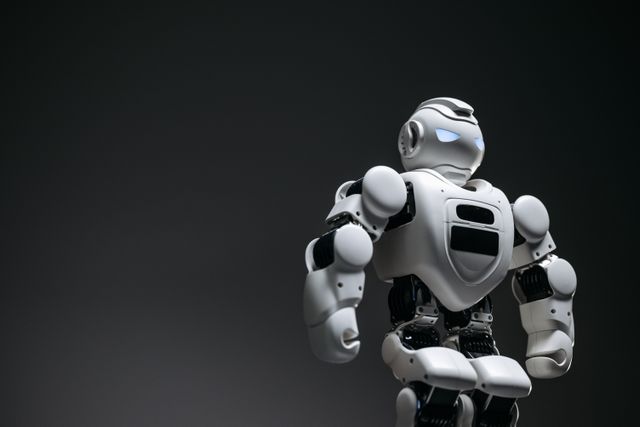
Rizzbot is the viral humanoid robot turning heads online. Here’s what it is, how it works, and why it became famous.
Rizzbot is the nickname of a customized Unitree G1 humanoid robot that became a viral social-media personality after appearing on streets in Austin, Texas, wearing a cowboy hat and delivering compliments, insults, jokes, and flirtatious lines. Its physical platform is real, but claims about exactly how much of its conversation is autonomous AI remain unclear; reporting has consistently described substantial human control.
What Is Rizzbot?
Rizzbot is essentially a humanoid robot turned into an internet character.
The machine is based on Unitree’s G1, a compact humanoid platform designed for movement, sensing, manipulation, and robotics research. Rizzbot’s distinctive personality comes from how that hardware is presented: cowboy hat, sneakers, chain, exaggerated slang, dramatic reactions, and a willingness to roast unsuspecting pedestrians.
The name is a joke built around “rizz,” modern slang for charisma or the ability to charm someone. The robot’s entire persona takes that idea literally: instead of quietly demonstrating robotics in a laboratory, it walks around looking for people to compliment, tease, flirt with, or surprise.
That unusual combination is what made Rizzbot stand out. A humanoid robot doing a controlled walking demonstration is interesting to robotics enthusiasts; a humanoid robot approaching strangers and commenting on their outfits is internet entertainment.
Rizzbot’s real trick is not simply being humanoid; it is turning robotics into a character people can recognize and share.
Why Did Rizzbot Become So Popular?
Rizzbot arrived at an unusually fertile intersection of robotics, memes, street interviews, and short-form video.
Its appearance does a lot of the storytelling before the robot even speaks. A relatively small humanoid wearing a cowboy hat and fashionable sneakers looks more like an eccentric internet celebrity than a piece of laboratory equipment. That makes every interaction immediately understandable without technical context.
The videos also follow a proven entertainment formula: approach a stranger, create uncertainty, deliver an unexpected line, then capture the reaction.
That matters because the viewer does not need to understand reinforcement learning, sensors, actuators, or robotics software. They simply see a strange little robot confidently walking toward someone and wonder what it will say.
Rizzbot’s TikTok account, @rizzbot_official, accumulated roughly 1.8 million followers and more than 92 million likes according to third-party tracking in July 2026. Those figures fluctuate, but they illustrate the scale of the character’s social-media reach.
Its videos have also traveled beyond the original account, with other users reposting or filming encounters and turning individual interactions into memes.
Is Rizzbot Actually AI?
This is where things get more interesting, and considerably less straightforward.
Rizzbot is often described online as an AI robot, but that phrase can mean several different things. A robot can contain AI software while still being remotely operated. Likewise, a robot can use pre-programmed movements while a human decides which behavior to trigger.
Reporting on Rizzbot has repeatedly identified human operation as an important part of the system. The Texas-focused reporting described the G1 as being operated through a manual controller, while TechCrunch reported that much of its behavior was pre-programmed and remotely triggered.
There has also been speculation that language models could be involved in generating or transforming some of the robot’s dialogue. TechCrunch discussed a possible setup involving an image of the person, an LLM, and text-to-speech, but explicitly presented that as an informed guess rather than confirmed architecture.
More recent reporting surrounding a lawsuit involving the robot has gone further in describing Rizzbot as remotely controlled rather than an autonomous AI system.
So the safest answer is:
Rizzbot is a real humanoid robot with sophisticated robotics hardware, but there is not enough publicly verified information to conclude that its viral conversations are generated autonomously by an onboard AI.
That distinction is important. “AI-powered humanoid” and “fully autonomous humanoid that independently decides what to say and do” are very different claims.
What Robot Is Rizzbot Based On?
Rizzbot is based on the Unitree G1, a commercially available humanoid robot developed by Unitree Robotics.
Unitree describes the G1 as an “AI avatar” and lists versions with between 23 and 43 joint motors. The robot is approximately 132 centimeters tall and weighs about 35 kilograms with its battery, depending on configuration.
Its hardware includes cameras and depth-sensing equipment, Wi-Fi 6, Bluetooth 5.2, a high-performance computing platform, and a removable 9,000mAh battery. Unitree lists battery life at approximately two hours under its stated specifications.
The physical robot is therefore much more capable than the goofy personality might suggest.
| Feature | Rizzbot / Unitree G1 |
| Robot type | Humanoid |
| Base platform | Unitree G1 |
| Height | About 132 cm |
| Weight | About 35 kg with battery |
| Joint motors | 23–43, depending on configuration |
| Battery | 9,000mAh |
| Claimed battery life | About 2 hours |
| Connectivity | Wi-Fi 6, Bluetooth 5.2 |
| Control | Manual control is part of reported Rizzbot operation |
| Primary viral role | Entertainment and social interaction |
Unitree currently lists the G1 at $13,500 on its international product page, excluding shipping, taxes, and other costs. Prices and configurations can change, so that figure should be treated as a current listed price rather than a fixed cost of building a Rizzbot clone.
How Does Rizzbot Move and Interact?
The easiest way to understand Rizzbot is to separate the body from the personality.
The body is robotics engineering: motors, joints, sensors, computers, batteries, control systems, and software. The G1’s design allows it to walk, balance, manipulate objects, and perform dynamic movements. Unitree says its locomotion and other capabilities are developed using imitation and reinforcement learning alongside simulation.
The personality is a different layer.
A person watching Rizzbot might perceive one seamless character: it sees someone, walks over, says something witty, laughs, dances, and moves away. Technically, those actions can be produced through a mixture of pre-programmed behaviors, remote commands, audio playback, perception systems, and potentially generative AI.
That is an important lesson about modern robots: a convincing social interaction does not necessarily mean the machine is independently reasoning through the entire interaction.
Rizzbot vs. a Typical AI Chatbot
Rizzbot is easy to confuse with an ordinary AI chatbot because both can appear conversational.
The difference is embodiment. A chatbot exists primarily in software; Rizzbot has a physical body that occupies space, moves through the environment, reacts to people, and has to deal with the messy physics of the real world.
| Rizzbot | Typical AI chatbot |
| Physical humanoid body | Software interface |
| Can walk and gesture | Cannot physically move |
| Uses robotics sensors | Primarily receives digital inputs |
| Can interact with people in public | Usually interacts through a screen |
| Requires power and physical maintenance | Runs on computing infrastructure |
| Can be remotely operated | Usually responds directly to user input |
| Combines hardware and software | Primarily software |
This physical presence explains part of Rizzbot’s appeal. A chatbot saying something outrageous is easy to ignore. A four-foot-ish robot waddling toward you in a cowboy hat while delivering the same line is a completely different experience.
Is Rizzbot Fully Autonomous?
No public evidence currently justifies treating Rizzbot as a fully autonomous humanoid.
That does not mean the robot is fake. Quite the opposite: the hardware is real, and the G1 is a sophisticated commercial humanoid platform.
The misconception comes from collapsing three separate concepts into one:
- Robot autonomy , the machine independently controls its physical actions.
- AI-generated dialogue , software generates language dynamically.
- Remote operation , a human selects or controls behavior.
A system can contain one, two, or all three.
For Rizzbot, publicly available reporting provides strong evidence for remote human control and programmed behaviors, while the exact role of generative AI in its dialogue has not been publicly documented in enough detail to make a definitive claim.
Who Created Rizzbot?
The story behind Rizzbot’s creators is less transparent than the robot itself.
Early reporting identified Kyle Morgenstein, a PhD student associated with robotics research at the University of Texas at Austin, as someone involved in training or developing the robot’s movements. TechCrunch reported that he worked with a team for roughly three weeks on behaviors including dancing and limb movement.
However, that does not mean Morgenstein is necessarily the robot’s owner.
TechCrunch reported that the owner was an anonymous YouTuber and biochemist, while later coverage identified Social Robotics LLC as the creator in connection with legal proceedings. Public reporting has therefore produced an evolving picture rather than a single completely documented ownership story.
That uncertainty has arguably helped Rizzbot’s mystique. The character feels less like a conventional product launch and more like an internet personality whose backstory is still being assembled.
What Happened to Rizzbot After It Went Viral?
Rizzbot’s popularity eventually moved beyond casual street videos.
The robot appeared in different locations and became recognizable enough to attract coverage from major technology and entertainment outlets. Its unusual mix of humanoid movement and deliberately provocative humor also generated controversy, particularly when physical interactions became more aggressive.
One major incident involved streamer IShowSpeed in September 2025. Social Robotics later filed a lawsuit alleging that the robot was assaulted and damaged beyond repair, with the company seeking $1 million in damages. Those are allegations in litigation, not findings that should be treated as established fact.
The incident illustrates something easy to overlook when watching viral robot videos: a humanoid robot used as entertainment is still expensive physical equipment operating around unpredictable people.
That creates safety and liability questions that do not arise in the same way with a purely digital meme.
What Rizzbot Tells Us About Humanoid Robots
Rizzbot is not necessarily the most technologically advanced humanoid robot in the world.
It may nevertheless be one of the better examples of how humanoid robotics can become culturally relevant.
A research demonstration asks, “What can this robot do?”
Rizzbot asks a different question: “What happens when this robot becomes a character?”
That distinction matters. Social robotics researchers have long examined robots through dimensions such as appearance, social capability, purpose, autonomy, and proximity to humans. Rizzbot compresses many of those ideas into an unusually visible public experiment.
The underlying G1 is also being used in serious robotics research. Recent 2026 research has tested reinforcement-learning approaches for walking, running, recovery, manipulation, and energy-efficient control on physical G1 hardware.
So the same robot platform can be a research platform in one context and a meme machine in another.
That’s probably the most fascinating part of Rizzbot.
What Should You Know Before Believing Viral Rizzbot Claims?
When a video makes Rizzbot look extraordinarily intelligent, separate what you can see from what the video actually proves.
A robot walking smoothly does not prove it is autonomous. A witty sentence does not prove an LLM generated it. A reaction that looks spontaneous does not prove the machine independently perceived and interpreted the situation.
The better question is: which part was handled by the robot, which part was software, and which part was a human operator?
That framework is useful far beyond Rizzbot. Viral demonstrations increasingly blur the boundaries between robotics, artificial intelligence, teleoperation, editing, and performance.
Frequently Asked Questions
What is Rizzbot?
Rizzbot is a viral humanoid robot based on Unitree’s G1 platform. It became famous for entertaining street interactions involving jokes, compliments, insults, dancing, and flirtatious dialogue.
Is Rizzbot a real robot?
Yes. Rizzbot is based on a real Unitree G1 humanoid robot rather than being a fictional or entirely computer-generated character.
Is Rizzbot controlled by a human?
Public reporting indicates that manual remote control plays a significant role in its operation. The exact division between remote commands, programmed behaviors, and any AI-assisted dialogue has not been publicly documented in full.
How much does the Unitree G1 cost?
Unitree’s international shop currently lists the G1 at $13,500, before shipping, taxes, and other applicable costs. Different versions and configurations can cost more.
Where did Rizzbot become famous?
Rizzbot first became strongly associated with Austin, Texas, where videos showed the humanoid robot interacting with people in public while wearing its now-famous cowboy hat.
Key Takeaways
- Rizzbot is a real humanoid robot based on Unitree’s G1 platform.
- Its cowboy hat, street interactions, slang, and outrageous personality turned robotics demonstrations into viral entertainment.
- Rizzbot should not automatically be described as a fully autonomous AI robot. Public reporting indicates significant human control and pre-programmed behavior.
- The exact role of generative AI in producing Rizzbot’s dialogue has not been publicly established in sufficient technical detail.
- The Unitree G1 has considerably broader capabilities than Rizzbot’s comedic videos suggest, including sophisticated sensing, movement, and manipulation hardware.
- Rizzbot demonstrates how physical presence can make AI and robotics dramatically more engaging than software alone.
- Its popularity also exposes an important distinction between a robot’s physical capabilities, its software intelligence, and the human operator behind the scenes.
A viral robot demonstration can show impressive behavior without proving full autonomy.
Additional Resources
- Unitree G1 Humanoid Robot: A useful first-party reference for the G1’s dimensions, hardware, battery, capabilities, pricing, and technical specifications.