
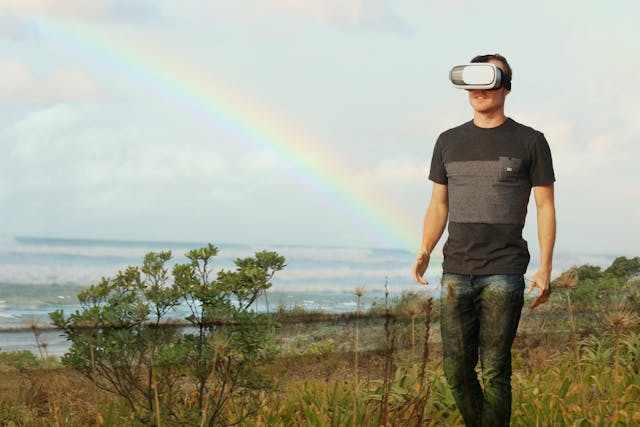
Experience virtual reality skydiving and discover how VR, motion systems, and wind tunnels are redefining human flight.
Virtual reality skydiving is an immersive experience that simulates freefall using VR headsets, motion tracking, wind tunnels, haptic feedback, and realistic environmental effects. It allows users to experience the sensation of skydiving without jumping from an aircraft, while also serving as a training and entertainment platform.
The strange thing about virtual reality skydiving is that most people expect it to be about graphics.
Then they try it.
And suddenly the graphics become the least interesting part.
The first time I watched someone step into a VR skydiving simulator, I expected something that felt like a video game with a dramatic soundtrack. Instead, what happened looked oddly emotional. The person hesitated before the jump. Their knees locked. Their breathing changed.
They knew they were standing safely on the ground.
Their brain disagreed.
That tension sits at the heart of virtual reality skydiving. It is not really about tricking your eyes. It is about convincing your body that gravity is part of the conversation.
Somewhere between entertainment technology, sports training, neuroscience, and human curiosity, a new category has emerged. People are no longer asking whether virtual reality can simulate flight.
They are asking how close it can get.
And surprisingly, the answer keeps changing.
What Is Virtual Reality Skydiving?
Virtual reality skydiving combines immersive VR technology with physical movement systems to recreate the sensation of freefall and aerial movement.
Depending on the setup, users may experience:
- A VR headset showing a realistic skydiving environment
- Motion-tracking systems that mirror body movement
- Wind effects that simulate airflow
- Physical harnesses or suspension systems
- Indoor wind tunnels integrated with virtual environments
The goal is simple.
Create the feeling of falling while remaining physically safe.
Researchers developed virtual jump simulators that required participants to physically jump from a platform while experiencing immersive virtual environments and tactile feedback. These systems were specifically designed to increase the sense of presence and realism.
That detail matters.
Many early VR experiences focused almost entirely on visuals. Virtual reality skydiving moved in a different direction. Developers realized that the body needed convincing too.
Why the Human Brain Responds So Strongly to Virtual Freefall
Falling occupies a strange place in human psychology.
Most people have dreamed about it.
Few people enjoy it.
Yet millions actively seek it.
Virtual reality skydiving taps into one of the oldest survival mechanisms in the nervous system. Your brain constantly predicts movement. When visual information suggests rapid descent, your body reacts before logic catches up.
That is why people often lean forward, grab imaginary surfaces, or instinctively spread their arms during VR flight experiences.
A simple quote captures the phenomenon:
“Presence is often more important than visual perfection.”
Researchers studying immersive VR environments repeatedly find that physical interaction increases the sensation of being somewhere else.
In other words, realism is not always about resolution.
It is about participation.
How Virtual Reality Skydiving Actually Works
VR Headsets Create the Visual World
Modern VR headsets generate stereoscopic environments that mimic real-world depth perception.
When users look down, they see thousands of feet of open air.
When they rotate their body, the environment responds instantly.
The illusion starts there.
But it cannot survive on visuals alone.
Wind Simulation Changes Everything
One of the biggest breakthroughs in virtual reality skydiving involves airflow simulation.
Researchers have found that localized wind stimulation can significantly enhance immersion in virtual environments.
This makes intuitive sense.
Imagine watching a virtual storm.
Now imagine feeling the wind hit your face at the same moment.
Your brain suddenly has fewer reasons to doubt the experience.
In skydiving simulations, airflow acts like a translator between virtual space and physical sensation.
Motion Tracking Connects Body and Environment
Real skydiving depends on body position.
Tiny adjustments create dramatic changes in movement.
Advanced VR skydiving systems track:
- Arm position
- Leg position
- Torso orientation
- Head movement
The virtual skydiver responds accordingly.
This creates an unusual learning loop.
Users begin understanding aerodynamic principles through movement rather than explanation.
Haptic Feedback Adds Physical Confirmation
Some systems incorporate vibration, resistance, or tactile feedback.
These cues reinforce virtual actions.
Pulling a parachute feels different from steering one.
The body notices.
The experience deepens.
Virtual Reality Skydiving vs Real Skydiving
This comparison sparks surprisingly heated debates.
Skydivers often argue that VR cannot replicate the true experience.
VR enthusiasts argue that realism improves every year.
Both sides are right.
Comparison Table
| Feature | Virtual Reality Skydiving | Real Skydiving |
| Physical Risk | Extremely low | Moderate to high |
| Cost Per Session | Low to moderate | High |
| Accessibility | Available year-round | Weather dependent |
| Fear Factor | Psychological | Psychological and physical |
| Wind Sensation | Simulated | Natural |
| Training Value | Useful for visualization | Essential for mastery |
| Adrenaline Level | Moderate to high | Extremely high |
| Repetition | Unlimited | Limited by budget and conditions |
The key difference may not be realism.
It may be consequence.
In real skydiving, every decision matters.
In VR, mistakes become information rather than emergencies.
That changes the emotional equation.
Can Virtual Reality Skydiving Train Real Skydivers?
This is where things become genuinely interesting.
For years, many athletes dismissed VR training as a gimmick.
The research is beginning to tell a more nuanced story.
Scientists have explored virtual skydiver models capable of simulating complex body-flight maneuvers. These systems help visualize posture changes and aerodynamic responses during freefall.
Another study proposed human-in-the-loop training systems where learners receive visual guidance for body positioning during simulated freefall. Participants successfully completed tasks that would have been extremely difficult without assistance.
That does not mean VR replaces skydiving instruction.
It means VR may accelerate understanding.
Think of it like a flight simulator.
No airline would replace actual flight hours entirely.
But no serious pilot ignores simulation training either.
The Rise of VR Wind Tunnel Experiences
Something fascinating is happening inside indoor skydiving facilities.
The physical environment already exists.
The airflow is real.
The body is genuinely floating.
Now VR technology is being layered on top.
Researchers have examined immersive skydiving simulations inside vertical wind tunnels, combining real aerodynamic forces with virtual environments.
This hybrid model may represent the future.
Not purely virtual.
Not purely physical.
Something in between.
Imagine floating in a wind tunnel while seeing yourself glide through the Grand Canyon, above the Swiss Alps, or between futuristic skyscrapers.
The body experiences flight.
The mind chooses the destination.
The Unexpected Problem: Motion Sickness
Every technological leap creates a new challenge.
For virtual reality skydiving, that challenge is often nausea.
Many users report intense motion sickness during simulated freefall experiences.
The reason is surprisingly simple.
Your eyes report movement.
Your inner ear reports stability.
Your brain receives conflicting data.
The result can feel terrible.
Researchers studying cybersickness found that improving alignment between visual and vestibular signals significantly reduces discomfort.
Real-world user experiences echo this finding.
VR enthusiasts frequently describe skydiving simulations as more nausea-inducing than many other VR genres.
Ironically, the closer developers get to realism, the more carefully they must manage the body’s sensory systems.
The Psychology of Fear in Virtual Reality Skydiving
This may be the most overlooked part of the experience.
Fear does not always require danger.
It requires belief.
People routinely hesitate before stepping onto virtual ledges.
Some refuse entirely.
Even while standing in a safe room.
Virtual reality skydiving exposes an uncomfortable truth:
Our emotional systems respond to perceived reality more than objective reality.
The body reacts first.
Logic catches up later.
That makes VR a powerful environment for exploring fear.
Not eliminating it.
Understanding it.
Popular Virtual Reality Skydiving Games and Simulators
Several developers have attempted to capture the freefall experience.
One of the most notable examples is Skydive Sim, a virtual skydiving simulator that combines VR mechanics with global terrain integration and multiplayer functionality.
Players can practice canopy control, experience emergency procedures, and explore realistic environments.
Community reactions remain mixed.
Some users appreciate the training value.
Others report significant motion sickness.
That contrast reveals something important.
Virtual reality skydiving remains a developing medium.
Nobody has perfected it yet.
And that uncertainty is part of what makes the space fascinating.
What the Future of Virtual Reality Skydiving Looks Like
The next decade may blur the distinction between simulation and experience.
Several technologies are converging simultaneously:
Better Haptics
Future systems may simulate airflow, pressure, and body forces with far greater precision.
Artificial Intelligence
AI could dynamically adjust environments, training programs, and flight conditions based on user behavior.
Mixed Reality Integration
Physical wind tunnels combined with virtual overlays may become more common.
Full-Body Tracking
The more accurately a system tracks movement, the more convincing body-flight simulation becomes.
A simple observation keeps surfacing across research:
The future of immersion is not more pixels.
It is more physicality.
The body wants evidence.
Developers are learning how to provide it.
Why Virtual Reality Skydiving Matters Beyond Entertainment
At first glance, virtual reality skydiving seems like a niche hobby.
A technological novelty.
A fun weekend attraction.
But underneath that surface sits a larger story.
Humans have always built tools that extend experience.
Books let us visit distant worlds.
Films let us witness impossible events.
Airplanes let us cross continents.
Virtual reality skydiving explores something slightly different.
It asks whether experience itself can become portable.
Whether the sensation of flight can be packaged, shared, repeated, and improved.
Not everyone will jump from an aircraft.
Millions never will.
Yet many still want to understand what it feels like.
Virtual reality skydiving exists in that space between imagination and reality.
And every year, that gap gets smaller.
FAQ
Is virtual reality skydiving realistic?
Modern systems can create highly immersive sensations of freefall, especially when combined with wind effects, motion tracking, and haptic feedback. However, they do not fully replicate the physical forces of real skydiving.
Can virtual reality skydiving help with training?
Yes. Some simulators are used for visualization, body-position practice, canopy familiarization, and freefall awareness. They supplement but do not replace professional instruction.
Does virtual reality skydiving cause motion sickness?
It can. The mismatch between visual movement and physical sensation may trigger nausea in some users. New technologies are actively reducing this issue.
Are VR skydiving simulators safe?
Generally yes. Most systems are designed with safety controls, harnesses, or stationary environments that minimize physical risk.
Is indoor skydiving with VR better than home VR skydiving?
Many users find wind tunnel integrations more immersive because they provide real airflow and body movement, reducing the disconnect between visual and physical sensations.
Key Takings
- Virtual reality skydiving combines immersive visuals, body tracking, and sensory feedback to simulate freefall.
- Wind effects dramatically improve the realism of virtual reality skydiving experiences.
- Research suggests VR can support skydiving training and skill development.
- Indoor wind tunnels paired with VR may represent the most convincing form of virtual flight available today.
- Motion sickness remains one of the industry’s biggest challenges.
- The psychological response to virtual freefall reveals how strongly the brain reacts to perceived movement.
- Virtual reality skydiving is evolving from entertainment into a legitimate tool for learning, exploration, and human performance research.
Additional Resources
- NASA Human Research Program: Research on human adaptation, sensory perception, and movement in extreme environments, including flight and space missions.