

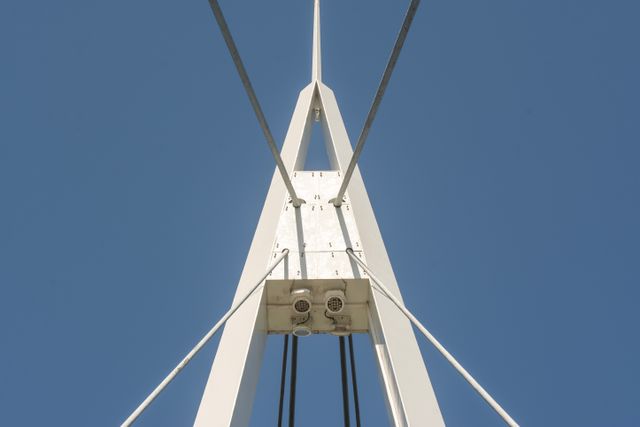
Discover who are the structure engineers of the Samuel Beckett Bridge and how they transformed a bold architectural vision into reality.
The structural engineers of the Samuel Beckett Bridge were Roughan & O’Donovan Consulting Engineers, who worked alongside renowned architect and engineer Santiago Calatrava, the bridge’s lead designer. Roughan & O’Donovan provided the civil and structural engineering expertise that helped turn Calatrava’s iconic concept into a functioning cable-stayed swing bridge in Dublin, Ireland.
Sometimes a bridge is just a bridge.
And sometimes it becomes a signature on a city’s skyline.
The Samuel Beckett Bridge in Dublin belongs firmly in the second category. The first time many people see it, they notice the dramatic white curve rising above the River Liffey. Some see a harp. Others see a sail catching the wind. A few even compare it to a giant skeletal fish frozen in motion.
Yet the more fascinating question isn’t what it looks like.
It’s how it stands.
When I started digging into who are the structure engineers of the Samuel Beckett Bridge, I expected to find a single famous name attached to the project. Instead, what emerged was a story about collaboration between visionary design and rigorous engineering. One side imagined the impossible. The other figured out how to make it survive storms, traffic, time, and gravity.
That partnership is what makes the bridge remarkable.
Who Are the Structure Engineers of the Samuel Beckett Bridge?
The direct answer is surprisingly clear.
The Samuel Beckett Bridge was designed under the leadership of Santiago Calatrava, the internationally renowned architect, structural engineer, and designer. However, the project’s civil and structural engineering work was carried out with the assistance of Roughan & O’Donovan Consulting Engineers (ROD), an Irish engineering firm that played a critical role in transforming the concept into a buildable structure.
In simple terms:
- Santiago Calatrava created the overall bridge concept and architectural vision.
- Roughan & O’Donovan engineered the civil and structural systems necessary to make that vision work safely and efficiently.
This distinction matters because modern landmark bridges are rarely the work of one person.
They’re conversations between imagination and mathematics.
The Role of Santiago Calatrava
More Than an Architect
One reason people become confused about who engineered the bridge is that Santiago Calatrava occupies a rare position in the design world.
He is both an architect and a trained civil engineer.
After studying architecture in Spain, he earned a doctorate in engineering from the Swiss Federal Institute of Technology in Zurich. This unusual combination allowed him to approach structures as both artistic statements and engineering systems.
Many architects sketch beautiful forms.
Many engineers calculate loads and stresses.
Calatrava does both.
That dual expertise explains why his bridges often resemble sculptures.
The Harp Inspiration
The Samuel Beckett Bridge was inspired by the shape of an Irish harp lying on its side, one of Ireland’s most recognizable national symbols. The curved pylon and radiating cables create this visual effect while simultaneously serving a structural purpose.
That’s a recurring theme throughout the project.
Nothing exists purely for decoration.
Even beauty has a job to do.
A Quotable Fact
“The Samuel Beckett Bridge was designed to combine architectural symbolism with functional engineering, allowing it to rotate 90 degrees for river traffic.”
The Critical Engineering Role of Roughan & O’Donovan
The Team Behind the Calculations
While Calatrava provided the vision, Roughan & O’Donovan handled much of the engineering reality.
According to the firm’s project documentation, they assisted with the civil and structural aspects of the bridge design, prepared contract documentation, performed technical checks, and designed the bridge approaches.
That might sound less glamorous than sketching a landmark structure.
But it’s arguably just as important.
A bridge isn’t judged solely by how it looks on opening day.
It’s judged by how it performs decades later.
What Structural Engineers Actually Do
Imagine someone hands you a sketch of a giant harp balancing over a river.
Your first question wouldn’t be whether it looks good.
It would be:
“Will it fall down?”
Structural engineers answer that question.
For the Samuel Beckett Bridge, they had to calculate:
- Cable forces
- Wind loads
- Traffic loads
- Dynamic movement
- Rotational mechanics
- Foundation stability
- Long-term fatigue performance
Every vehicle crossing the bridge creates stress.
Every gust of wind creates movement.
Every year adds wear.
The engineering team had to account for all of it.
A Quotable Fact
“Roughan & O’Donovan assisted with the civil and structural design of the Samuel Beckett Bridge and carried out major technical verification work.”
Why the Bridge Was an Engineering Challenge
It’s Not Just a Bridge
Many people don’t realize the Samuel Beckett Bridge is actually a cable-stayed swing bridge.
That means it performs two separate jobs.
First, it functions as a standard road bridge carrying vehicles, cyclists, and pedestrians.
Second, it rotates horizontally to allow vessels to pass along the River Liffey.
Combining those functions significantly increases engineering complexity.
Balancing Weight and Motion
A traditional bridge stays still.
The Samuel Beckett Bridge moves.
That changes everything.
Engineers had to ensure that the bridge remained perfectly balanced during rotation while still supporting thousands of tons of structural steel, cables, and roadway. The bridge rotates through 90 degrees using a mechanism housed within the base of the pylon.
Think of it like building a giant Swiss watch.
Except the watch weighs thousands of tons.
Engineering Meets Art
This is where the collaboration between Calatrava and Roughan & O’Donovan becomes especially visible.
The sweeping pylon appears elegant and effortless.
In reality, it’s the result of precise calculations involving load distribution, cable tension, and structural equilibrium.
Beauty here is engineered.
Understanding the Structural System
The Cable-Stayed Design
The bridge uses a cable-stayed configuration supported by 31 cables connected to a curved steel pylon. These cables transfer loads from the deck to the main support structure.
Without those cables, the deck would require a much heavier and deeper support system.
Instead, the cables create a lighter and more visually striking solution.
The Inclined Pylon
One of the bridge’s defining features is its forward-leaning curved pylon.
This isn’t merely artistic.
The shape helps manage structural forces while contributing to the bridge’s iconic appearance. The pylon rises approximately 46–48 meters above the river.
The Foundation System
Less visible but equally important are the foundations.
The bridge’s intermediate pier transfers enormous forces into underlying limestone bedrock, ensuring long-term stability.
Visitors admire the pylon.
Engineers admire the foundations.
Both perspectives are correct.
How the Bridge Was Built
Fabrication in Rotterdam
An interesting detail often overlooked is that the steel superstructure was fabricated in Rotterdam, Netherlands.
Once completed, the massive structure was transported by barge to Dublin for installation.
That’s a logistical feat in itself.
Building the bridge was one challenge.
Moving it was another.
Construction Partnership
The bridge was constructed by the Graham Hollandia Joint Venture, bringing together expertise in steel fabrication, heavy transport, and installation.
This highlights another truth about modern engineering:
Landmark structures rarely belong to one genius.
They emerge from networks of specialists.
Comparing the Key Figures Behind the Bridge
| Role | Organization/Person | Main Contribution |
| Lead Designer | Santiago Calatrava | Architectural and engineering vision |
| Structural Engineering Support | Roughan & O’Donovan | Civil and structural engineering design |
| Construction Team | Graham Hollandia Joint Venture | Fabrication and assembly |
| Client | Dublin City Council | Project commissioning and oversight |
| Steel Fabrication | Hollandia | Manufacturing of steel structure |
Why People Often Credit Only Calatrava
The Visibility Problem
Architects often receive the headlines.
Engineers often receive the calculations.
That’s not criticism. It’s simply how public attention works.
The Samuel Beckett Bridge is widely associated with Santiago Calatrava because his visual signature is immediately recognizable. Similar design themes appear in several of his famous bridge projects worldwide.
But Engineering Is Collaborative
The reality is more nuanced.
Without Calatrava, the bridge would not look the way it does.
Without Roughan & O’Donovan, it might never have been built at all.
The bridge exists because both disciplines worked together.
That’s perhaps the most interesting answer to the question.
Awards and Recognition
The engineering community quickly recognized the significance of the project.
The Samuel Beckett Bridge won the Engineers Ireland Engineering Project of the Year Award in 2010, highlighting not only its architectural impact but also its engineering achievement.
Awards don’t guarantee greatness.
But they often reveal what professionals admire.
In this case, engineers admired the bridge’s successful combination of aesthetics, functionality, and technical innovation.
A Quotable Fact
“The Samuel Beckett Bridge won Engineers Ireland’s Engineering Project of the Year award in 2010.”
The Lasting Legacy of the Structural Engineers
When discussing who are the structure engineers of the Samuel Beckett Bridge, it’s tempting to focus on names alone.
Yet the more meaningful answer may be found in what they accomplished.
They created a bridge that functions as infrastructure.
They created a bridge that moves.
They created a bridge that symbolizes Dublin’s modern identity.
Most importantly, they proved that engineering doesn’t have to hide behind utility.
It can become part of a city’s story.
The Samuel Beckett Bridge stands today not merely because someone imagined it, but because skilled structural engineers found a way to make that imagination withstand reality.
FAQ Section
Who are the structural engineers of the Samuel Beckett Bridge?
The structural engineering work was carried out with the involvement of Roughan & O’Donovan Consulting Engineers, working alongside lead designer Santiago Calatrava.
Was Santiago Calatrava an engineer or an architect?
He is both. Calatrava studied architecture and later earned a doctorate in civil engineering.
What type of bridge is the Samuel Beckett Bridge?
It is a cable-stayed swing bridge that can rotate 90 degrees to allow river traffic to pass.
Why does the bridge look like a harp?
The design was inspired by the Irish harp, a national symbol of Ireland.
When was the Samuel Beckett Bridge completed?
Construction was completed in 2009, and the bridge opened to the public that year.
Key Takings
- The answer to who are the structure engineers of the Samuel Beckett Bridge includes both Santiago Calatrava and Roughan & O’Donovan.
- Santiago Calatrava served as the bridge’s lead designer and architectural visionary.
- Roughan & O’Donovan provided essential civil and structural engineering expertise.
- The bridge is a cable-stayed swing bridge capable of rotating 90 degrees.
- Its iconic shape was inspired by Ireland’s national symbol, the harp.
- The project required advanced engineering to balance movement, strength, and aesthetics.
- The bridge won Engineers Ireland’s Engineering Project of the Year award in 2010.
Additional Resources:
- Santiago Calatrava Official Project Archive: Official project details, design philosophy, technical specifications, and construction history from the bridge’s lead designer.